
Beyond a Watermark: Why Sustainability in Advertising Still Matters
In 2026, sustainability seems like a buzzword that people are pulling away from. Greenwashing headlines and net-zero claims that fall short, but making real, tangible steps towards sustainability in advertising still makes a real difference – not just for your brand’s image, but in your revenue stream.
One of the main reasons companies deprioritise sustainability in their business is cost; the cost-of-living pressures make it seem like a difficult goal to achieve, but actual sustainability practices come with benefits, tax breaks, savings over time, and building consumer trust.
What is Sustainability in Advertising?
It may sound simple enough, but sustainable advertising is the practice of promoting brands, products and services in a way that minimises environmental harm across the full lifecycle of the materials used.
That includes the substrates and inks used in print, the energy consumed in production, how far materials travel, and, critically, what happens to them at the end of life.
In large-format print specifically, the conversation has always focused on what something looks like. Sustainable advertising asks what it leaves behind.


It Starts Before You Print
Sustainability in advertising starts with the choices that happen before the first design is sketched: material selection, supplier standards, production methods, logistics, and planning for what to do with the sign after the campaigns finish.
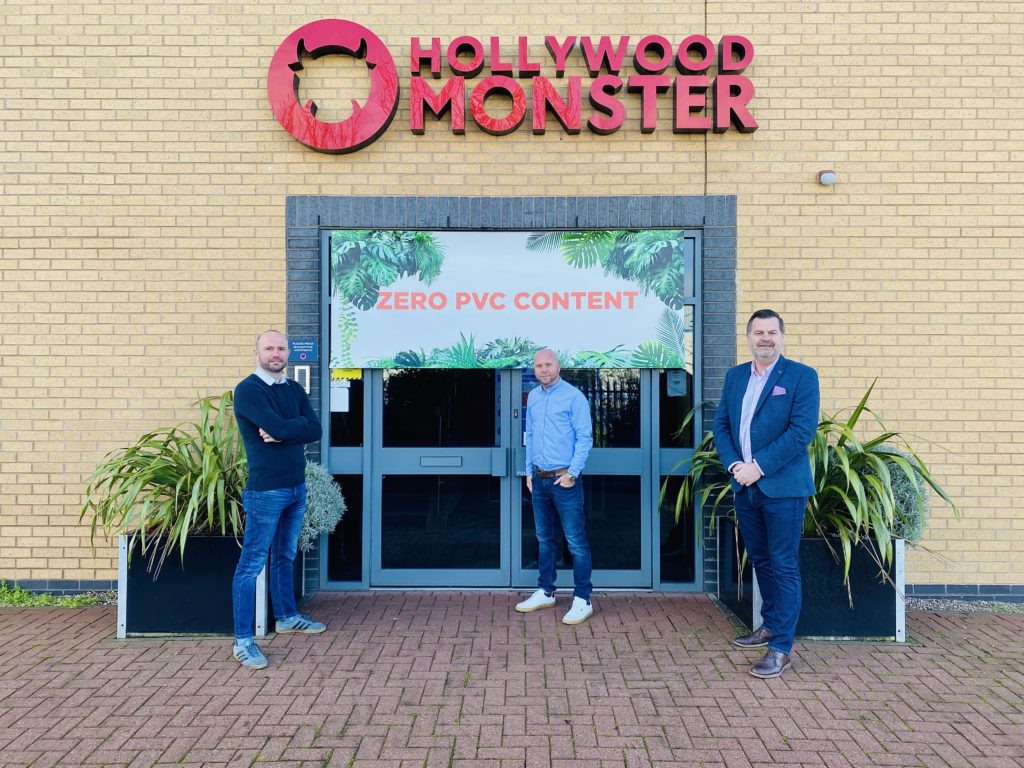
At Hollywood Monster, sustainability is at the heart of everything we do, from design and print to installation, not because it’s easy to sell, but because it’s the right thing to build a business around.
This starts with small choices, using PVC-free substrates, recyclable options in the UFabrik range and a recycling scheme that’s accredited with FESPA, which has reduced landfill contribution by 80%.
This is what it takes to create real, sustainable choices. It has to be embedded into every part of your process.
Why Sustainability in Advertising Matters More Than Ever
Corporations are making this commitment, and the pace at which they’re making these commitments is increasing every year; not making these choices means getting left behind. According to PwC’s 2025 energy survey of 800 UK businesses and public sector organisations;
“The proportion of businesses committed to achieving net zero by 2030 has nearly doubled since last year’s survey, rising from 28% to 47%.”
When nearly half of UK businesses are committing to hit net zero by 2030, the brands they work with and the agencies they brief need to be ready to meet that expectation.
These commitments aren’t just a nice-to-have; there’s a real financial element that many miss. Investment in sustainability isn’t just an ethical choice; it can be a tax-efficient one.
For brands and their suppliers, this changes what a sustainable infrastructure can offer. Investment in greener equipment, greener production and greener materials is not the financial burden it once was.



What Makes Advertising More Sustainable?
Sustainability is a series of decisions that happen across the entire lifecycle of your materials, from the substrate that gets loaded onto the press to what happens once the campaign comes down. Most brands only ever think about the first part. The ones who do it properly think about all of it.
Here is how it breaks down in practice.
Sustainable Advertising Materials
The materials you use are the most significant way to impact sustainability in advertising. For a long time, PVC dominated large-format print because it was cheap, durable and widely available. But it’s wasteful, non-recyclable in mainstream UK waste streams, and when it goes to landfill, it stays there.
The alternatives have caught up. Kavalan, the PVC-free banner material Hollywood Monster switched to across all its banner work, offers the same look, feel and durability as traditional PVC, can be welded, weighs 50% less (reducing transport emissions), and can be incinerated to generate energy rather than sitting in a landfill.
UFabrik made a significant change in how sustainability in advertising is done, manufacturing from recycled plastic bottles, converting waste into a high-quality substrate for wall coverings, hanging banners and display frames.
Sugar cane-based vinyl prints make a massive change to your sustainability targets, and apply almost identically to their PVC equivalent. These are not compromises; these are sustainable choices that don’t compromise on impact.
For inks, water-based and Greenguard-certified options are now standard on the right production equipment. They print onto uncoated surfaces, which increases the biodegradability of finished materials, and they eliminate a significant category of chemical output from the print process.
Sustainable Print Production
The machinery behind the print matters as much as the material going through it. LED curing systems use around 70% less electricity than standard UV printers. Direct printing onto uncoated substrates can reduce material use by over 30% compared to coated alternatives. Consuming at 2kWh per hour, the right equipment can cut carbon emissions from the production process by up to 80% compared to older technology.
None of that shows up on a creative brief, but it shows up on a carbon report.
Sustainable Advertising Logistics
A supplier with a single UK production facility and a national installation network concentrates the carbon cost of distribution rather than multiplying it across multiple regional sites. It is a relatively simple structural advantage that compounds across large-volume jobs. Less travel per square metre is a sustainability win that requires no material change to the end product.
End-of-Life Recycling for Advertising Materials
End-of-life planning has to be built into the brief; this gets overlooked constantly. A well-produced, beautifully printed banner that goes straight to landfill at the end of a campaign is not a sustainable outcome.
Having a process like a recycling scheme with a FESPA-accredited provider like Reconomy, that compacting waste materials at its Tyseley facility for collection, sorting and recycling into second-life products, means your signage doesn’t go to waste.
A dedicated process makes all the difference. By partnering with a FESPA-accredited provider like Reconomy, waste materials are collected and processed, ensuring your signage doesn’t go to waste.
Materials like Kavalan take this further; partnered with Howe to Recycle, it carries a guaranteed end-of-life pathway rather than leaving disposal to chance, and when you’re producing signage in bulk, this difference matters.
Reusable Advertising Systems & Modular Displays
The most sustainable material is the one you do not have to replace. Modular exhibition systems, like those available through a beMatrix bePartner status, are built to be reconfigured rather than rebuilt.
The structural frame is reused across events; only the graphic panels change. For brands that exhibit regularly, the reduction in material consumption over a two- or three-year exhibition calendar is considerable. It is also a faster, less complicated build and strike process, which has real value when you are working to tight venue windows.


Sustainability in Advertising Across Different Industries
Sustainability is not a one-size-fits-all conversation. The pressures, timelines and reporting requirements differ significantly depending on where your advertising sits. Here is how it plays out across sectors.
Sustainable Retail Advertising
Retail signage has one of the highest material turnover rates of any sector. Seasonal refreshes, promotional campaigns, window graphics and POS displays all contribute to a significant volume of print that needs replacing on a regular cycle. The temptation is to specify cheap and replace often. The result is a hidden cost in repeat installs and material disposal that rarely gets totalled up.
The other pressure in retail is ESG reporting. Listed REITs, pension-backed funds and large LLPs are now reporting Scope 3 emissions. PVC vinyl is the dominant material across most retail and isn’t recycled in the UK. The shift to sustainable alternatives is increasingly a procurement decision that also makes the reporting numbers easier to manage.
Sustainable Event & Exhibition Advertising
The events sector has historically operated on a build-once, discard-after culture. Single-use stands, single-use graphics, single-use everything. That model is increasingly difficult to justify to procurement teams and ESG leads, particularly for brands that exhibit at multiple shows a year.
The answer is modular. Going with options like beMatrix offers brands the ability to design an exhibition presence that redresses rather than rebuilds. The frame system is reused; the graphics panels are updated. The brand impact is the same. The material waste is a fraction. Read more about the beMatrix partnership here.
Sustainable Property & Development Signage
Property and development signage typically means hoarding, building wraps and site dressing at scale. These materials can stay in place for months or years, which changes the sustainability calculus. Durability and end-of-life planning matter more than in shorter-cycle applications. Hoarding that lasts the length of a development without degrading or requiring replacement is a better environmental outcome than one that gets swapped out twice during a site’s build phase.
For developers with sustainability credentials to protect, the substrate choice and disposal route are part of the story, not a footnote.
Sustainable Hospitality Branding
Hospitality clients often operate across multiple sites with brand consistency requirements, which creates both a challenge and an opportunity. Managing material specification centrally, across a rollout, means sustainable choices can be locked in at a procurement level rather than left to individual site decisions. Interior signage, wayfinding, printed wallcoverings and window graphics all benefit from a consistent, sustainable brief applied at scale.
Sustainable Sports & Stadium Advertising
Sports and stadium signage operate under a unique set of pressures. Visibility at scale, durability in exposed conditions, rapid turnaround around fixtures, and an audience that is increasingly vocal about the environmental practices of the clubs and venues they support.
PVC-free pitch-side and perimeter options, LED displays over printed static signage, and end-of-life recycling for seasonal graphics are all part of what a credible sustainability approach looks like in this sector.
Sustainable Corporate Interiors
Corporate interiors are where sustainability becomes most personal for the people inside the building. Printed wallcoverings made from recycled fibres, signage produced with Greenguard-certified inks, wayfinding systems specified for longevity rather than seasonal replacement: all of it contributes to an environment that backs up the values a business publishes in its annual report.
The brands that get this right are doing it because the people who work for them notice, and so do their clients.
Does Sustainable Advertising Save Money?
The assumption that sustainability costs more is understandable. In isolation, some sustainable materials carry a small premium over their conventional equivalents. But that comparison only holds if you look at the unit cost in isolation.
The real cost of cheap materials is rarely totalled. A low-cost banner that fails early, a material specified for six months that gets replaced twice, a single-use exhibition stand that is built and discarded across three shows a year: none of those replacement and disposal costs sits neatly in a line marked “bad decision.” They get absorbed into subsequent purchase orders, and the original savings look intact.
Sustainable materials are specified for durability. Kavalan weighs less than PVC, which reduces transport costs at volume. Modular exhibition systems cost more upfront and cost considerably less across a three-year event calendar. Reusable materials are, by definition, materials you are not buying again. These are not marginal gains.
There is also a more direct financial argument, one that the government has made unusually explicit.

In April 2023, the government introduced full expensing for capital investment. According to Kaplan’s analysis of the scheme:
“Introduced in April 2023, full expensing allows companies to deduct 100% of qualifying capital investment – such as energy-efficient equipment – from their taxable profits in the year of purchase.”
For organisations investing in greener infrastructure, whether that is energy-efficient production equipment, sustainable display systems, or fit-out built around recyclable materials, the tax position has become meaningfully more favourable. A capital investment that reduces your environmental footprint and reduces your tax liability in the same year is not a difficult decision to make.
Then there is brand risk, which is harder to quantify but very real. Greenwashing accusations hurt reputations, and advertising materials that contradict a published sustainability commitment create a PR issue teams spend weeks trying to stop. The safest position is the one where the materials do what the brand says they do, because they were specified by a supplier who can prove it.
Sustainability in advertising is not a premium option for companies with the budget to make ethical choices. It is increasingly the lower-risk, lower-cost choice for companies that plan beyond the next purchase order.
Sustainable Advertising Doesn’t Mean Smaller Ideas
The biggest advertising campaigns shouldn’t leave the biggest environmental footprint. The right materials, smarter production and better planning allow brands to create work that delivers real impact without creating unnecessary waste.
At Hollywood Monster, sustainability isn’t a separate service. It’s built into how we design, print and install everything from exhibition graphics and building wraps to retail campaigns and nationwide rollouts. Because creating a #MonsterImpact shouldn’t come at the planet’s expense.
Ready to Build a More Sustainable Campaign?
Whether you’re planning a nationwide rollout, replacing PVC materials or looking for lower-impact alternatives without compromising visual impact, we’ll help you find the right solution.
Speak to our team about sustainable advertising that makes an impact without the environmental cost.
Financial Information
The information above is intended as general guidance only and should not be considered financial or tax advice. Tax reliefs, including Full Expensing, depend on your organisation’s circumstances. Always speak to a qualified accountant or financial adviser before making investment decisions.
Frequently Asked Questions
What is sustainability in marketing?
Sustainability in marketing is the practice of promoting products and services while reducing environmental impact and supporting responsible business practices. This includes sustainability in advertising, ethical messaging and environmentally conscious campaign delivery.
Why is sustainability important in advertising?
Consumers, investors and procurement teams increasingly expect brands to demonstrate measurable sustainability commitments. Sustainability in advertising helps reduce waste, supports ESG reporting and can improve long-term operational efficiency.
What materials are used in sustainable advertising?
Common sustainable advertising materials include PVC-free banner media, recycled PET fabrics such as UFabrik, recyclable aluminium systems and water-based or Greenguard-certified inks. These alternatives reduce waste while maintaining high-quality print performance.
Is sustainable advertising more expensive?
Not always. While some sustainable materials carry a higher upfront cost, they can reduce transport, replacement and disposal costs over time. Reusable display systems and longer-lasting materials often provide better long-term value.
How can businesses make their advertising more sustainable?
Businesses can improve sustainability by choosing recyclable or PVC-free materials, working with suppliers that operate recycling schemes, investing in reusable display systems and selecting energy-efficient production methods.
