If you’re still pinning your hopes on a static, fading poster and wondering why the world is passing you by, it’s time for a wake-up call. In a world that moves at the speed of a fibre-optic cable, good enough print is invisible. To get noticed, you have to dominate. You have to move. You have to glow.
At Hollywood Monster, we don’t just do digital; we orchestrate brand revolutions. But before you can own the room or light up a stadium, you need to understand the mechanics behind the magic. So, how does digital signage work, and why has it become the undisputed heavyweight champion of modern marketing? Let’s strip back the LEDs and look at the engine room.
THE ANATOMY OF ATTENTION: HOW DOES DIGITAL SIGNAGE WORK?
At its simplest, digital signage is a digital ecosystem designed to deliver content to a physical space. It isn’t just a TV on a wall – it is a coordinated symphony of hardware, software, and connectivity.
1. The Face: The Display Technology
This is what your audience sees. Whether it’s an Indoor LED Screen with P1.8 pixel resolution for stunning intimacy or a Stadium-Sized Video Wall, the display is the canvas.
- LED (Light Emitting Diode): Unlike traditional screens, LED displays consist of thousands of tiny light sources. This allows for the ultra-bright performance Hollywood Monster is known for. We’re talking about brightness levels up to 2,200cd/m², bright enough to punch through direct sunlight and demand a double-take from across the street.
- LCD (Liquid Crystal Display): Often used for smaller, high-definition indoor applications like digital menu boards or interactive touch screens.

2. The Heart: The Media Player
Behind every show-stopping screen is a media player. This is the physical hardware that tells the screen what to show. It processes the video, images, or live data feeds and pushes them to the pixels. Modern players are compact, powerful, and built to run 24/7 without breaking a sweat.
3. The Brain: Content Management System (CMS)
This is where the revolution happens. A CMS allows you to update your message with the touch of a button. Gone are the days of waiting for a van to arrive with a new vinyl wrap. With a cloud-based CMS, you can change a price in Birmingham, a video in London, and a greeting in Manchester – all from your laptop in seconds.
4. The Nervous System: Connectivity
To work in real-time, digital signage needs a pulse. Whether it’s via Wi-Fi, Ethernet, or 5G, connectivity allows the CMS to talk to the media player, ensuring your content is always fresh, always relevant, and always on.
WHY IS DIGITAL SIGNAGE THE NEW INDUSTRY STANDARD?
The shift from static to digital isn’t just a trend; it’s an evolution. Here is why the most fearless brands in the world, from McDonald’s to Adidas, are ditching the flat and going digital.

Stopping Power (The “Science of the Squint”)
Humans are biologically hardwired to notice two things: light and motion. A static sign is a suggestion; a digital display is a command. When you use ultra-bright displays that dominate a space, you aren’t just showing an ad; you’re seizing the audience’s attention. That’s why digital signage achieves a significantly higher dwell time than traditional media because it is physically impossible to ignore and has a huge recall rate of 83%, nearly double the retention rate of traditional static advertising.
Real-Time Agility
In the retail and hospitality sectors, timing is everything.
- Morning: Your digital boards show breakfast deals and coffee.
- Afternoon: They shift to lunch specials.
- Evening: They electrify the space with cocktail promotions and mood-setting visuals.
This isn’t just advertising; it’s integrated digital signage that lives in the now, reacting and refreshing to match the pulse of your environment.
Unlimited Scalability
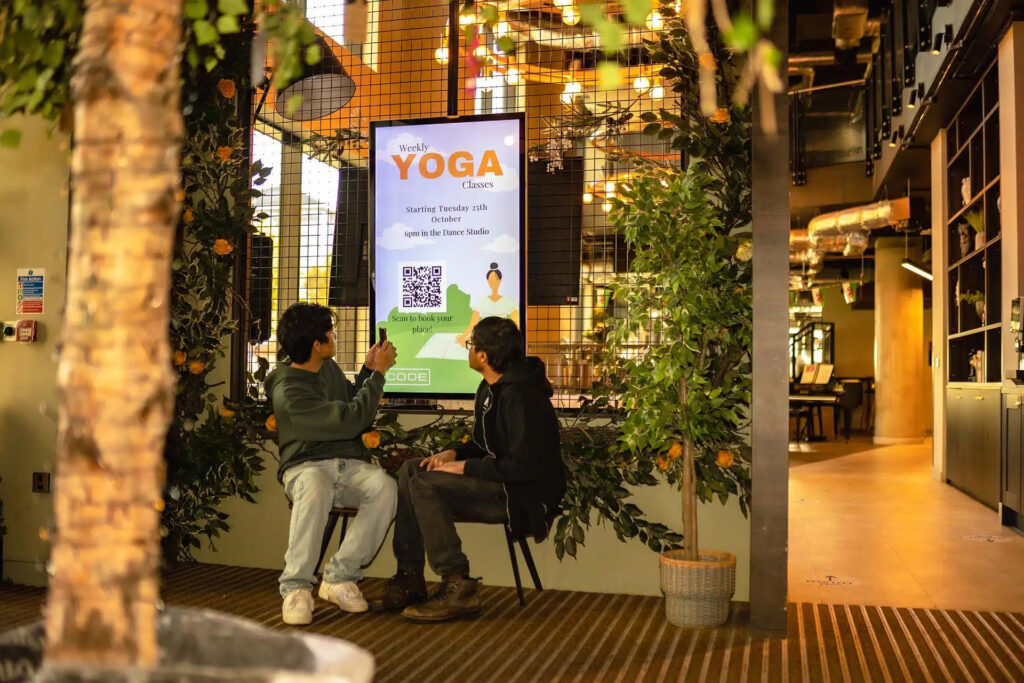
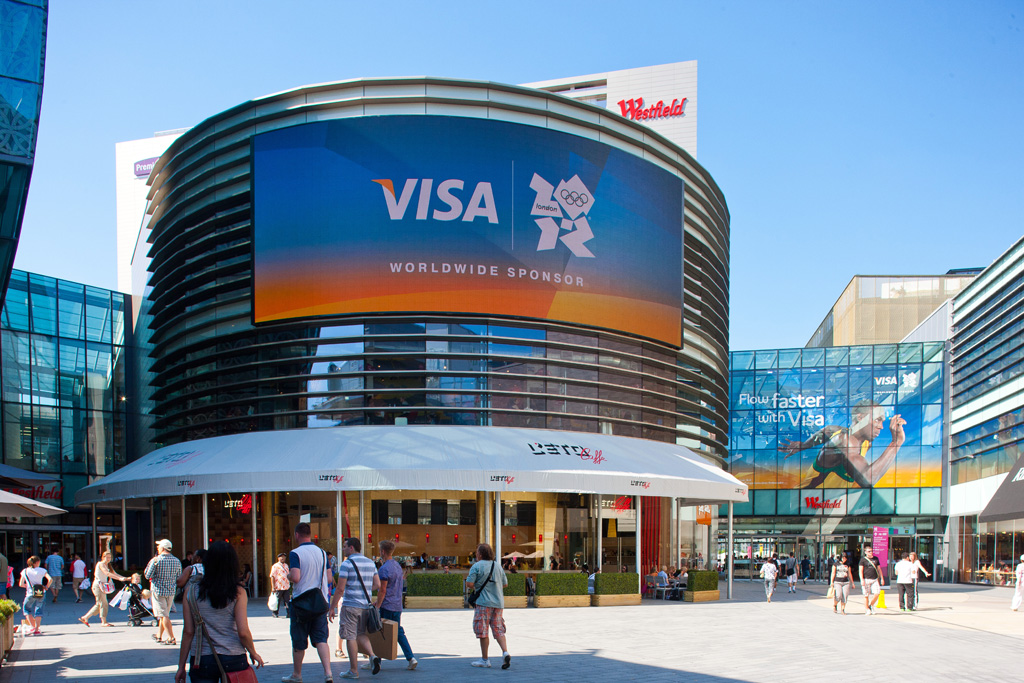
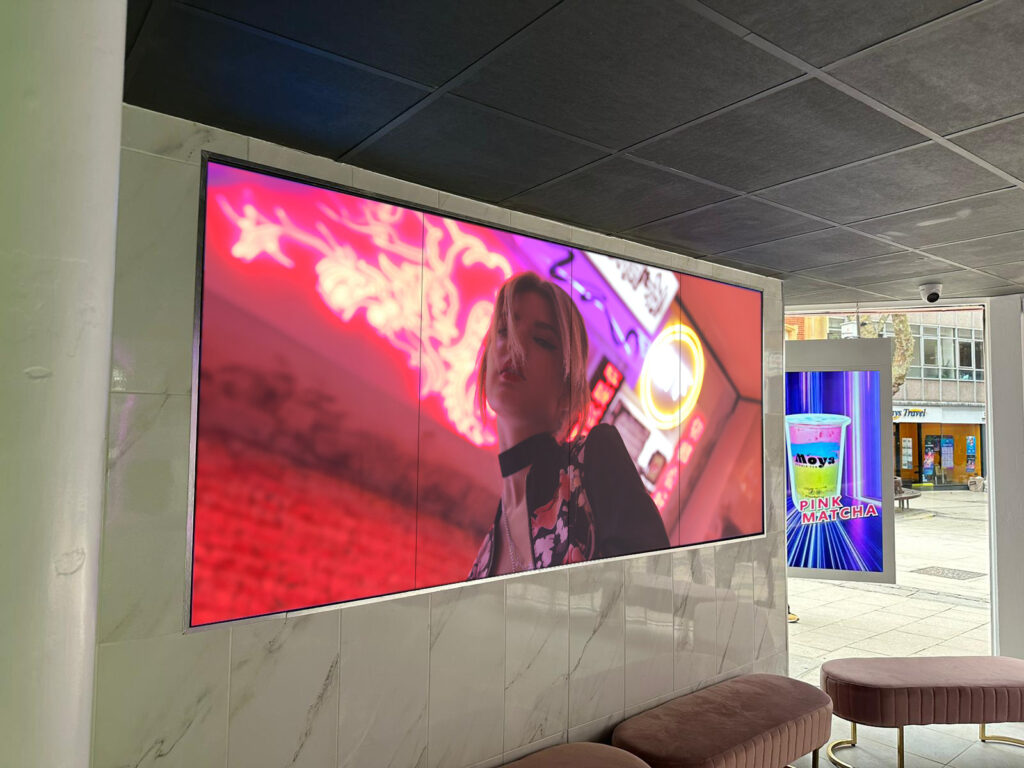
Why settle for a single screen when you can own the entire wall? Video walls (using 49” or 55” panels) allow brands to create massive, immersive environments. Whether it’s a shopping centre atrium or a stadium entrance, the ability to scale your message is something static print simply cannot match.
THE ENVIRONMENTAL CHALLENGE: OUTDOOR VS. THE ELEMENTS
When we talk about how digital signage works in the wild, we have to talk about the battle against the Great British weather. Outdoor signage is a completely different beast to anything you’d find in a lobby.
Dominating the Skyline
Outdoor digital displays have to survive rain, snow, and, most difficult of all, the sun. Standard screens wash out when the sun hits them, and to remain unmissable, outdoor LED screens require massive light output (often measured in Nits or Candelas).
But it’s not just about being bright; it’s about being smart. Modern outdoor displays use sensors to adjust their brightness based on the ambient light. This ensures that at 2:00 PM on a sunny July afternoon, your message is screaming with clarity, but at midnight, it’s not blinding the local traffic. It’s this adaptability that makes digital so popular for stadiums and high-footfall retail parks – it’s a living, breathing part of the architecture.
THE ART OF THE CLOSE-UP: THE INDOOR REVOLUTION
While outdoor signage is about big statements, indoor digital signage is about intimate experiences. This is where the technical term ‘pixel pitch’ becomes the star of the show.
Seamless Luxury
If you’re standing two metres away from a screen in a luxury showroom or a corporate lobby, you shouldn’t be able to see the individual dots of light. You want a seamless, liquid-like image. This is achieved through a fine pixel pitch (like P1.8 or P2.5).
The popularity of indoor LED comes down to its ability to turn vacant space into a profit centre. Imagine a corporate lobby that doesn’t just have a logo on the wall, but a floor-to-ceiling digital canvas that welcomes guests by name, shows live social feeds, or displays mesmerising 3D art. This is integrated digital signage – it’s not just a screen; it’s a mood-setter.
SUSTAINABILITY: THE GREEN ENGINE BEHIND THE GLOW
One of the most common misconceptions about digital signage is that it’s an energy hog. In reality, the industry is undergoing a massive green shift. At Hollywood Monster, we don’t think sustainability is a footnote; it’s the core of our engineering.
We were incredibly proud to receive the UK Graphics Awards Green Award in 2024, because for us, impact isn’t just about how many people see your sign; it’s about the footprint you leave behind.
The Shift to Smarter Power
Modern LED technology is remarkably efficient. Compared to traditional fluorescent-lit lightboxes, current LED displays use up to 44% less energy. Because digital content can be updated remotely, you’re also eliminating the constant cycle of printing, shipping, and landfilling PVC banners.
In 2024 alone, we diverted 250,000kg of waste from UK landfills. By choosing digital, brands like Aldi and McDonald’s are meeting their ESG goals without losing an ounce of their visual authority. It’s the ultimate win-win: you shine brighter, but you tread lighter.
BEYOND ADVERTISING: THE MULTI-TOOL OF COMMUNICATION
If you think digital signage is only for selling trainers or burgers, you’re missing the bigger picture. Its popularity is surging because it has become the ultimate multi-tool for modern spaces.
Wayfinding & Navigation
In massive hubs like ExCeL London, digital signage acts as a dynamic concierge. It doesn’t just show you where the hall is; it tells you how long it takes to walk there and what’s happening when you arrive.
Internal Comms
Corporate giants are using digital video walls to keep their teams connected. It’s the watercooler of the 21st century – displaying KPIs, celebrating wins, and keeping the company culture pulsing.
Crisis Management
In an emergency, every screen in a building can instantly shift from promotion to instruction. That kind of agility saves lives.
READY TO MAKE A #MONSTERIMPACT?
Stop playing small. Whether you need a stadium-sized video wall, an interactive retail display, or a sustainable LED revolution, the team at Hollywood Monster is ready to turn your biggest ideas into digital reality.
Book your free creative consultation today. Let’s build a brand experience that is impossible to ignore.
NEWS


Light Up the Night: Illuminated Signs for Businesses That Win
The Materials That Make Retail Shop Signage Actually Work

