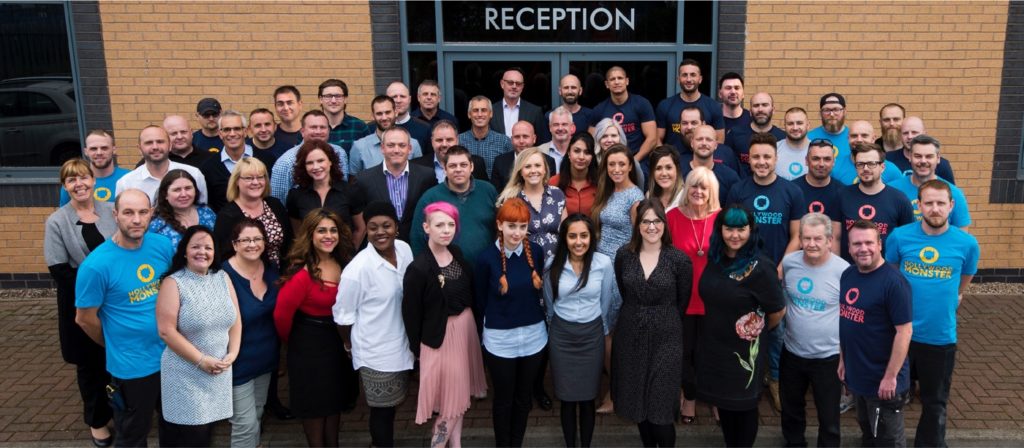
The students from ITG arrived with a campaign that had only ever existed on a laptop. They had invented new food products for two well-known fast food chains and built a campaign around them, shooting their own photography and producing TikTok content to go with it.
We put them in with our artworkers. They used their own photography to lay out marketing posters, sent the files to our wide-format flatbed, and stood at the machine while the prints came off. Those posters went straight into a pitch to the restaurant account directors.
ITG have been a client of ours for over ten years, and hosting their students has become part of our calendar. This year was twenty of them in our Tyseley facility for the afternoon.
The bit you can’t teach on a monitor
A design changes when it becomes an object. Colour reads differently once it has been UV cured and hung under retail lighting. Type that feels right at 100% on a calibrated screen can go thin and apologetic at two metres. Background texture that gave a thumbnail some depth turns to noise at scale.
Explaining this in a seminar is one thing. It’s a very different thing to believe it. Until you have watched it happen to your own work. Students who see it once start thinking about the finished output while they are still designing, rather than finding out about it afterwards, and that habit stays with them wherever they end up working.

Multichannel includes the channels you can touch
The students had covered a lot before they arrived. Product concepts, photography, short-form video, and a campaign story that held together across all of it.
What none of it had done yet was leave the digital environment. That matters, for the brands we print for a campaign that only lives online is half a campaign. The same creative has to survive as a poster in a store, as hoarding around a construction site, on an exhibition stand, and sometimes wrapped across the front of a building.
Every one of those has its own substrate, scale, lighting condition and lifespan. Holding a brand together across them while respecting what each format needs is a genuine discipline, and almost nobody teaches it.
So we spent time on how our work sits inside what our clients are actually trying to do. Print is not the last stop in a process. It shapes what is possible much earlier, and the campaigns that come out best are the ones where somebody thought about the physical output at the start.
Inside Tyseley
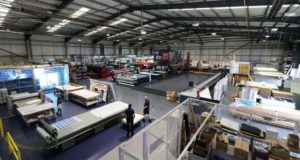
Our headquarters runs to 45,000 sq ft, and the students saw most of it.
The SwissQprint Kudu flatbed prints across rigid and flexible substrates with the colour consistency a national rollout depends on.
Our EFI VUTEk M3h is a UV LED hybrid platform, built for volume work without dropping quality. Finishing goes through the Hasler Magna, a 5-metre conveyor cutter and one of only a handful in the country, with a camera registration system that reads printed marks as it goes and corrects for any drift while it cuts.
With past print and cutting projects including fabrication, specialist finishing, and a nationwide installation operation.
Showing a group of marketing students around a factory wasn’t about the machinery. It is so they understand that between a signed-off artwork file and a poster hanging in a restaurant, a dozen people make a dozen decisions, and every one of them can go wrong.


Sustainability
We walked them through what we do and why we do it. The eco substrates. How our recycling actually works, rather than how it looks on a slide. Low-energy printing and the water-based inks we use.
Hollywood Monster has been reducing the footprint of the work long before anyone put it in a tender document. It is how we would want to run a factory in Birmingham, regardless of whether we had to.
Students coming into this industry should know what that looks like in practice and be able to tell the difference between a company doing the work and a company describing it.


Why we keep opening the doors
Hollywood Monster began as a family business more than thirty years ago. The people who trained our first generation of staff did it by putting them on the shop floor and letting them get it wrong a few times. Nothing better has come along since.
There is a skills shortage in large-format print and signage, and part of it is access. Most people never see what happens between a design and a building wrap, and it is difficult to want a job you have never watched anyone do.
An afternoon in our facility does not fix that, but it does mean twenty more people know the work is here.
“You cannot learn this from a screen. Watching your own artwork come off a flatbed at full size teaches you something no lecture will. We were letting people onto the shop floor when this was a family firm in a much smaller unit than the one we have now, and we have never seen a reason to stop. This industry needs people who understand what print can do physically, and the only way to build that is to show them.”
Tim Andrews MBE, Chairman, Hollywood Monster
ITG will be back next year. So will we.
NEWS


Light Up the Night: Illuminated Signs for Businesses That Win
The Materials That Make Retail Shop Signage Actually Work

